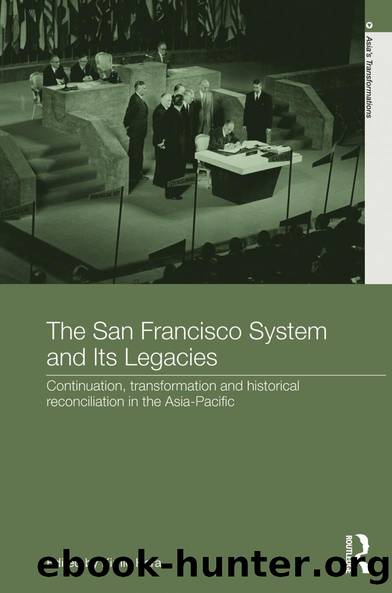
The San Francisco System and Its Legacies by Kimie Hara
Author:Kimie Hara [Hara, Kimie]
Language: eng
Format: epub
ISBN: 9781138794788
Barnesnoble:
Publisher: Taylor & Francis
Published: 2014-11-27T00:00:00+00:00
The inception of the San Francisco System, Japan divided
Part of the price of âindependenceâ under the SFPT was the division of the country into âpeace stateâ (demilitarized and constitutionally pacifist mainland Japan) and âwar stateâ (American-controlled Okinawa), the former under strong, indirect American influence and the latter under direct US military rule. Mainland Japan became a semi-independent âprotectorate,â lacking foreign and defense powers and with only qualified economic and social policy powers. Okinawa, âNansei Shoto south of the 29 degree North latitude (including the Ryukyu Islands and the Daito Islands)â became a UN-authorized âtrusteeship,â âwith the U.S. as the sole administering authority.â10
In at least two significant respects, the same emperor who had led Japan through the war played the key role in determining its structure and role in the post-war period. First, despite having assumed office deprived of political powers and defined as a âsymbol of the state and unity of the people,â he called for the United States to extend its occupation, telling General MacArthur that he believed Japanâs security depended on âinitiatives taken by the United States, representing the Anglo-Saxons,â and to that end the United States should maintain its military occupation of Okinawa âfor 25, or 50 years or longer, under the fiction of a long-term lease.â11 The imperial pledge is rarely mentioned today. It meant the emperor approved the division of Japan and the long-term US occupation of Okinawa. The heart of the Pax Nipponica was transferred to and continued to beat in the Pax Americana. In fact, General MacArthurâs first demand of the drafters of the new Japanese constitution in 1946 was that âthe emperor is at the head of the state.â12
Second, when President Trumanâs special envoy, John Foster Dulles, conveyed the American request for the right to maintain military bases in Japan even after the peace treaty, and Prime Minister Yoshida refused, the emperor sent a message via his aide saying that he favored the idea; despite his reluctance, Yoshida bowed to the imperial will.13 While all six Japanese delegates to San Francisco signed the peace treaty on the morning of September 8, it was he alone who, that same afternoon at Sixth Army Headquarters, signed the accompanying (and much more controversial) Security Treaty.14 Under this latter treaty, Japan granted to the United States the right to station land, air, and sea forces in and about Japan, and to use them
to contribute to the maintenance of international peace and security in the Far East and to the security of Japan against armed attack from without, including assistance given at the express request of the Japanese Government to put down large scale internal riots and disturbances in Japan.
The effect was that the US occupation did not end, but was henceforth legitimized. The forces who until April 28, 1952 were part of the âoccupationâ were from April 29 stationed in the same bases and doing the same things, but they were Ampo (US government) treaty-based forces. The national polity (kokutai), built around the emperor in pre-war times, was recast along lines determined in significant measure by that same emperor.
Download
This site does not store any files on its server. We only index and link to content provided by other sites. Please contact the content providers to delete copyright contents if any and email us, we'll remove relevant links or contents immediately.
| Arms Control | Diplomacy |
| Security | Trades & Tariffs |
| Treaties | African |
| Asian | Australian & Oceanian |
| Canadian | Caribbean & Latin American |
| European | Middle Eastern |
| Russian & Former Soviet Union |
The Secret History by Donna Tartt(19088)
The Social Justice Warrior Handbook by Lisa De Pasquale(12190)
Thirteen Reasons Why by Jay Asher(8910)
This Is How You Lose Her by Junot Diaz(6887)
Weapons of Math Destruction by Cathy O'Neil(6280)
Zero to One by Peter Thiel(5802)
Beartown by Fredrik Backman(5754)
The Myth of the Strong Leader by Archie Brown(5507)
The Fire Next Time by James Baldwin(5446)
How Democracies Die by Steven Levitsky & Daniel Ziblatt(5219)
Promise Me, Dad by Joe Biden(5153)
Stone's Rules by Roger Stone(5088)
A Higher Loyalty: Truth, Lies, and Leadership by James Comey(4964)
100 Deadly Skills by Clint Emerson(4925)
Rise and Kill First by Ronen Bergman(4789)
Secrecy World by Jake Bernstein(4753)
The David Icke Guide to the Global Conspiracy (and how to end it) by David Icke(4720)
The Farm by Tom Rob Smith(4512)
The Doomsday Machine by Daniel Ellsberg(4490)
